Feed a language model the phrase “the bank of the river,” and its attention mechanism scans every other word in the sentence, scores how relevant each one is, and lets “river” pull “bank” away from a dozen possible meanings toward exactly one: a landmass, not a financial institution. “River” doesn’t just sit near “bank.” It is the context that makes “bank” mean something specific.
An AI agent working inside a business resolves ambiguity the same way, just at a much larger scale. Its instructions, however precisely written, work like “bank” on its own: generic until something disambiguates them into one correct action. What it takes to get there is a goal, the right context, real-time data, and the tools to act on all three: four ingredients that carry equal weight and don’t work alone. A goal without tools can’t be executed. Context without real-time data goes stale. Tools without either just do the wrong thing faster.
But the hardest ingredient to keep reliable over time is data as context, meaning data that’s current and described well enough to mean one specific thing at the exact moment an agent acts on it.
When the data behind an agent is wrong, nothing looks wrong
Context can fail a model in two ways: too little of it, and the model guesses; too much of it, unfiltered, and the signal that matters drowns in noise. The same two failures happen at the data layer, harder to notice because nothing crashes.
An agent reasoning over a customer record that’s three systems and two days out of date doesn’t throw an error. It reaches a confident, wrong conclusion, in the same tone it would use for a correct one. That’s a reliability failure: the data wasn’t good enough to act on.
The other failure is quieter, and it can happen even when the data is perfect. An agent can have the freshest record available and still get it wrong, because nobody told it that “active policy” means something specific to this business, or that a segment is off-limits for a given offer. It’s the same gap that separates “bank” from “riverbank” before something disambiguates it, and the person on the other end, a customer whose claim gets approved or denied on that misunderstanding, feels the difference even when the agent never does. Both failures look identical to success until someone checks the output against reality.
Real-time data was always part of the picture
None of this is a gap in a governed map of instructions and tools. A Context Catalog already lists data and metadata among what it tracks, connected through typed, directed relationships that make it behave less like a directory and more like a knowledge graph, able to answer how two things relate and not just where each one lives. Data was never the missing ingredient. It was priced in from the start, the same way “river” was always somewhere in the sentence before the model learned to weigh it.
What data needs, though, differs from what an API endpoint needs. An endpoint’s shape changes on a release cycle; a customer record can change five times in the minute it takes to read this sentence. Mapping data once tells an agent where it lives, but it doesn’t tell the agent whether what’s sitting there right now is still true. That takes an approach built for how data actually behaves: fragmented across systems never designed to talk to each other, trustworthy only if someone can verify, in real time, where it came from and whether it’s still current.
What it actually takes to trust data in real time
Getting there takes three things, whatever an organization ends up calling them:
- Knowing what data exists and who’s responsible for it, the way a kitchen needs its pantry labeled before anyone can cook from it, so “customer” means the same thing whether marketing, claims, or an agent is asking.
- A paper trail showing where each piece came from and what it passed through, the way a supply chain traces a shipment back to its batch, so a change can be assessed before it ships and audited after the fact instead of taken on faith.
- Freshness that doesn’t depend on someone remembering to hit refresh, the difference between a live scoreboard and a stale newspaper.
Mia-Platform’s Data Fabric approach
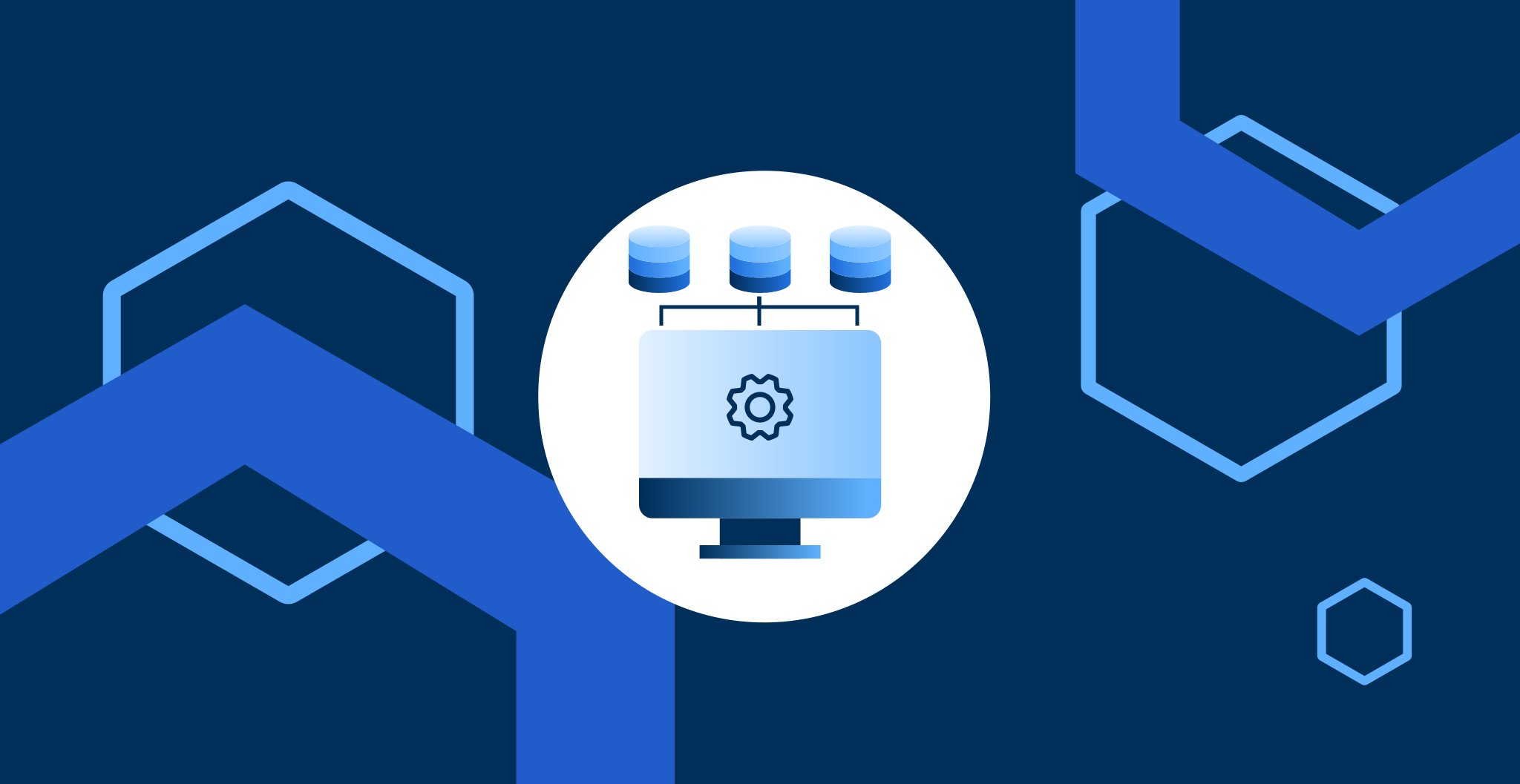
Data fabric is a fairly established idea in enterprise data architecture: it unifies data from existing enterprise systems into a single governed layer instead of ripping them out and starting over. It’s what gives the pantry label, the paper trail, and the scoreboard an operational shape instead of leaving them as analogies. The goal isn’t to introduce a new system of record, but to make the ones already in place behave as a single, trustworthy source of context for agents.
Turning those three requirements, inventory, provenance and freshness, into something an agent can rely on takes a few concrete capabilities:
- A searchable inventory of what exists and who owns it. In practice, this looks like a Data Catalog: a unified record of datasets, pipelines, and models pulled from wherever enterprise data lives, from Oracle and Postgres to MongoDB, Salesforce, and SAP HANA, paired with a shared Data Glossary so terms like “claim” or “policy” mean the same thing to every team and every agent that asks.
- A paper trail for every piece of data. Data Lineage, from table level up to system-of-record level, shows where data originated and what it passed through, so a change can be assessed for impact before it ships and audited after the fact.
- Freshness that doesn’t depend on someone remembering to hit refresh. This is where a Fast Data layer comes in: an engine decouples data from the systems that first produced it and maintains a single, governed view updated as those sources change. Not everything needs that pace: a quarterly report can still wait for a batch job, but an AI agent making real-time decisions cannot.
In an implementation like the one used at Mia-Platform, these capabilities are wired together so the sync between Data Catalog and Fast Data runs continuously. A Job Runner inside the catalog schedules scans that keep its metadata aligned with what Fast Data actually serves, while an Open Lineage Service tracks provenance across both. The result is a map that describes fresh, accurate, and clean data around the clock.
From raw data to a grounded decision
Laid out end to end, a data fabric approach and a governed Context Catalog, what the wider industry sometimes calls an enterprise context layer, are not alternatives: they are stages in one pipeline. What travels through it is data as context, picking up meaning, provenance, and freshness at each handoff before an agent ever acts on it. On the agent side of that pipeline, the work runs through AI Foundry. That’s the platform where AI Playbooks, the reusable, governed workflows an agent executes, get built and supervised.