Enterprise Vibe Coding: How to Build Your Internal Apps Quickly, Securely and Autonomously

Key Takeaways
- Digital departments are seizing the opportunity to claim autonomy and validate ideas by embracing vibe coding.
- Unfortunately, however, uncontrolled vibe coding harbors many pitfalls related to the black-box nature of proliferating AI platforms. The solution is to ground vibe coding in reality with enterprise-grade guardrails and context.
- With enterprise vibe coding, the digital department shifts from being a mere requester of services to an active engine of co-creation, capable of transforming every business insight into a ready-to-use digital solution.
- If you want your digital team to bridge the gap between design and fast validation, Mia-Platform provides the framework to stop discussing ideas and start building them.
Introduction
Digital innovation is shifting beyond traditional coding. Within digital departments, hybrid professionals who bridge business and IT are already using no-code to convert ideas into tangible solutions. Now, they are crossing an even more disruptive frontier: Vibe Coding.
For those who have already experienced the freedom of no-code tools, this shift represents the ultimate opportunity to break down the last remaining technical barriers. It is a push toward unprecedented creative and operational autonomy, enabling companies to respond to market needs in real-time.
Let’s be honest: turning a conversation into a functional tool so quickly is addictive. Indeed, vibe coding gives anyone the sense that their ideas can come to life and work out almost instantly.
But this new energy cannot clash with the organization’s internal processes, compliance, and security. Most vibe coding tools are external and suffer from poor integration, necessitating a shift toward internal, enterprise-ready solutions.
To be truly effective, vibe coding must shift from casual experimentation to a fully governed process, capable of communicating with IT and seamlessly integrating into corporate ecosystems, avoiding the risk of creating isolated black boxes.
The Evolution From No-Code to Vibe Coding
Business agility often collides with IT backlogs. Teams like Digital Product & Innovation, Marketing, HR, Finance, and Operations need immediate tools, whether it is an expense tracker app, an onboarding portal, a performance review dashboard or a scheduling app.
However, relying on a developer solely for prototyping or validating ideas is not only frustrating but also costly and time-consuming.
That’s why the adoption of no-code has drastically accelerated. It’s a strategic way to validate ideas faster, relieve IT pressure, and give autonomy back to the business. This is not a passing fad. Gartner (Forecast Analysis: Low-Code Development Technologies, Worldwide, November 2025) predicts that the number of citizen developers will quadruple by 2029. Beyond a mere statistic, this represents a golden opportunity that the most forward-thinking digital departments are already seizing to transform internal operations.
Now we are witnessing a physiological transition toward the next logical step: vibe coding.
If no-code lowered the walls with the immediacy of visual blocks, vibe coding breaks them down, closing the gap between an initial concept and a functional pilot. Here, innovation lies in crafting applications simply by conversing with AI in natural language, making development even more accessible; digital teams can finally experiment and create at much lower costs and time.
The Limitations of External Tools (the “Black-Box” Problem)
Vibe coding is inevitably seductive, especially in its initial phase. The idea of going from a sketch to a working prototype in hours is thrilling. But its unstructured adoption creates technical debt and governance gaps, trading immediate speed for long-term integration and standardization challenges.
Today, many digital professionals are experimenting with external AI platforms like Claude, Lovable or Gemini. Although extremely powerful, these tools actually act as “black boxes” that work in a bubble. The main issue is that they lack a structural connection with your organization’s context: they ignore your security policies, bypass your design system, and remain dangerously disconnected from your enterprise repositories.
From an operational standpoint, those who have already tried these tools quickly encounter a series of technical frustrations:
- Always starting from scratch: Design-wise, the major hurdle is the lack of component portability, which prevents the reuse of previously developed and approved elements.
- The shrimp effect: With every change request in chat, the AI tends to regenerate and overwrite the entire application code. Two steps forward for a new feature and one step back, mysteriously losing pieces of code or functionality already approved.
- Stopping at frontend: Lacking the ability to isolate, track, and version individual changes in a granular way, development quite often stops at the frontend level, abandoning users when they need structured solutions for the backend and data persistence.
- Memory leak: Tools easily lose track of conversations when context is scattered across separate files rather than built into their foundation.
- Security risks: Without adequate tests and embedded security guardrails, system vulnerabilities are highly likely to proliferate.
- Lack of context: It exacerbates the frustrating need to manually enter design and brand guidelines, or technology standards like React each time.
- Lack of archiving: You live with a million files for infinite prompts. These prompts become essentially your application’s “business descriptions,” but get lost in chats because they are not structurally archived.
Such an unregulated acceleration leads to shadow IT, where employees build their own unmanaged apps that bring in security risks and technical debt. Without proper guardrails and standards, the organization becomes responsible for design system mismatches, architectural flaws and vulnerabilities it didn’t formally approve.
However, far from suppressing this innovative drive, the goal is to channel it within a secure and governed technological perimeter.
The Solution: Vibe Coding in an Enterprise Context (Enterprise Vibe Coding)
To transform the excitement of prototyping into a real competitive advantage, you must bring AI out of its black-box and harness it in a governed, integrated, and guardrail-protected environment.
Basically, you need to achieve an actionable context layer that allows for a quick start and a seamless integration of all your internal processes. It goes through two interrelated elements:
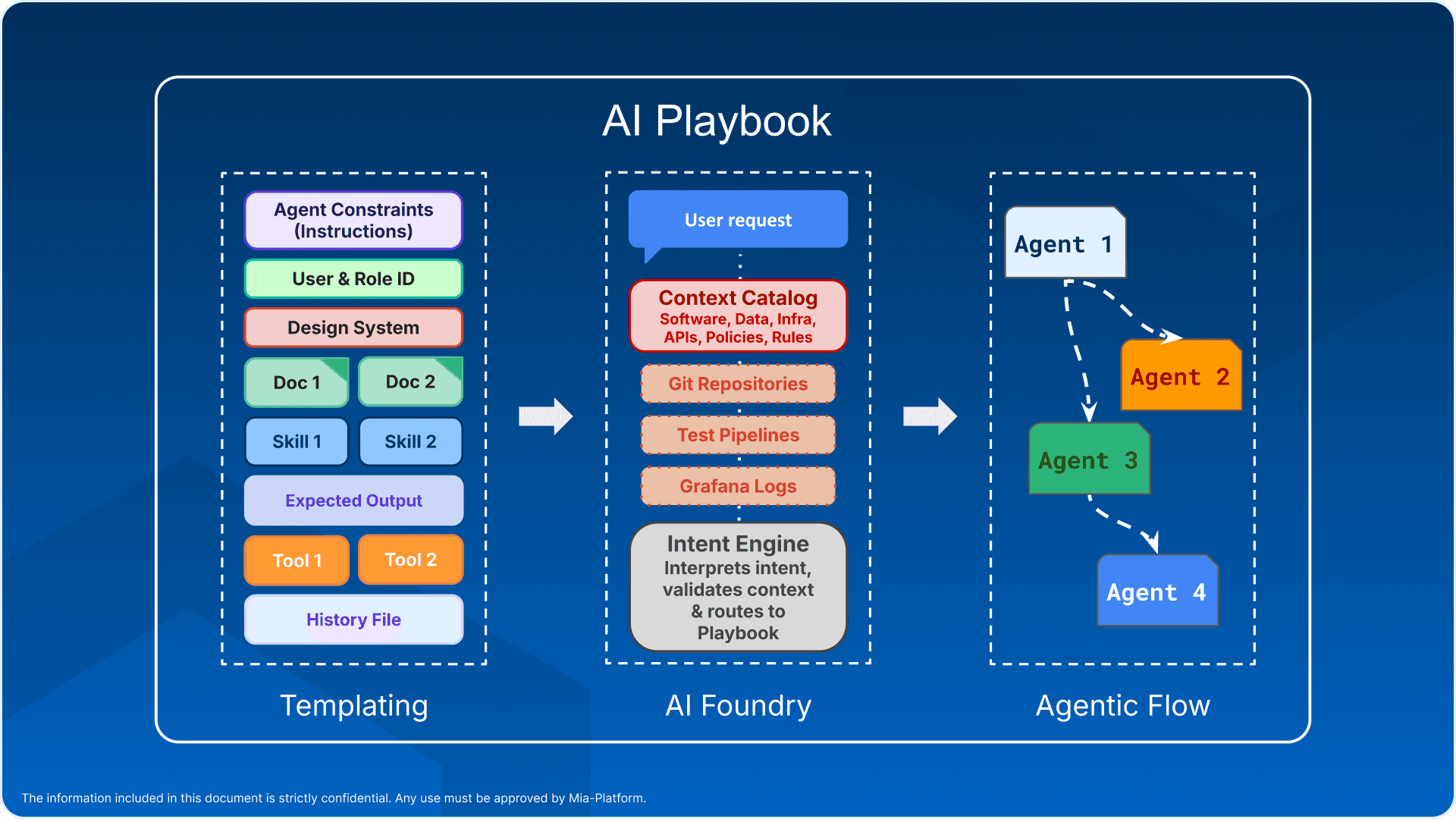
- AI Playbook Library: A foundational layer where you build modular bricks, skills, and tools. Acting as predefined templates, these building blocks automatically inject user identity, brand guidelines, and technologies into prompts in a spec-driven way, eliminating rewrite bottlenecks. Think of the AI as a colleague: within each template, you define their role, accessible tools, operational rules, strict brand constraints and expected outputs. Assembling these modules creates a library to configure, deploy, and scale custom AI agents fully aligned with your business processes.
- Context Catalog: The comprehensive, dynamic archive of the work done. It can start empty (a quick tactical approach) and gradually grow, or connect immediately to the IT world to inherit existing code repositories, infrastructure resources and data products.
How Mia-Platform Addresses Enterprise Vibe Coding
Mia-Platform combines the speed of vibe coding with the rigor required for enterprise governance.
Rather than creating “shadow” applications, the platform integrates organically and securely into business processes, overcoming the limitations of external tools through:
- Intent management and reuse: Instead of losing instructions in volatile chats, Mia-Platform formalizes prompts into structured “intents” powered by the AI Playbook Library. Through these predefined, reusable templates, you standardize agent behaviors, tooling access, and governance parameters from a central catalog. These modular building blocks turn natural language into precise technical specifications (like Angular or React) and design systems (brand guidelines, visual identity, etc). Functioning as versioned documentation, the library allows you to easily track changes, modify applications, and scale tailored AI capabilities without losing the original business logic.
- Mapping and governance: The Context Catalog acts as a digital twin that maps your entire ecosystem. From software to data, infrastructure, APIs and policies, it feeds AI models with governed context to reduce token use, latency and errors. It embeds compliance standards, corporate rules and access controls from the start, and enforces structural guardrails for reliable and secure ongoing operations.
- Deep integration and data persistence: Mia-Platform connects your app directly to existing systems like a CRM, an ERP, or Excel spreadsheets. The AI supports the entire process, from data import to building structured databases and a reliable backend.
Prototyping and Validation: From Concept to Reality
The transition from business insight to production is typically where projects stall. The solution to this roadblock isn’t to force the process, but to establish a common language. Mia-Platform actively turns the design phase into a technical validation tool.
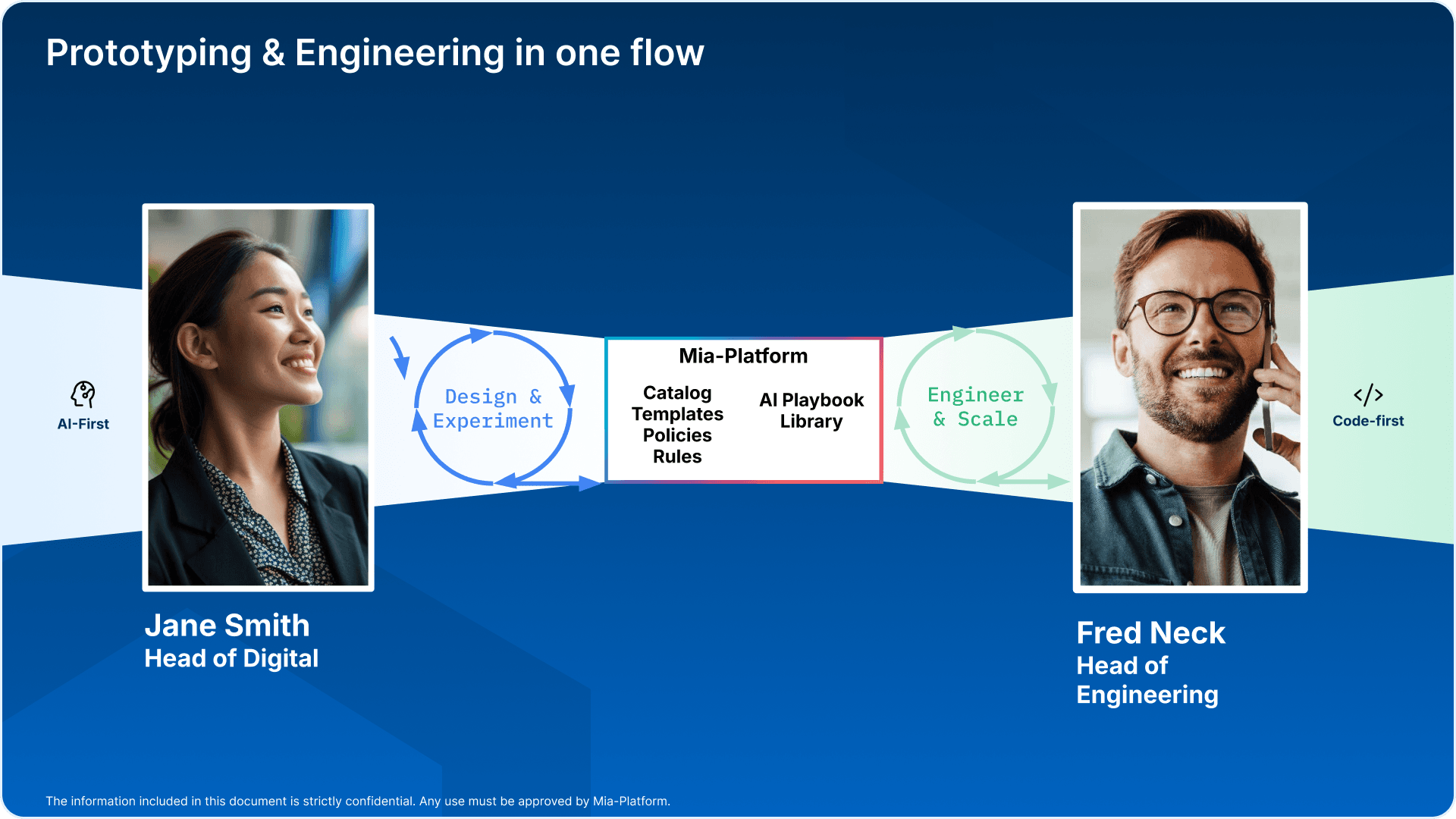
Instead of presenting an abstract idea or a black-box prototype, digital teams can present IT with a pre-validated project, grounded in a deep semantic understanding of the existing codebase via the Context Catalog.
This approach tangibly addresses structural rigidities and external dependencies.
Overcoming dependence on outsourcing (Retail)
Many retail companies rely on small internal IT departments and external suppliers, turning any changes into months-long bottlenecks. Thanks to a governed ecosystem like Mia-Platform, the digital team can prototype and validate ideas internally in real time. Only after validation the project is handed over to suppliers for final development, eliminating “wait time” costs.
An incremental path in regulated sectors (Financial Services)
Adoption can be gradual. Initially, the Context Catalog is used to generate accurate technical specifications and clear structural outputs, such as architectural PDFs or isolated UI components, based on the internal context. Then follows direct prototyping: the business creates applications that inherit all IT governance rules by default, leaving engineers only the final implementation on an already compliant infrastructure and standardized resources.
By merging the immediacy of vibe coding with enterprise-grade guardrails and context, digital departments can instantly turn insights into working prototypes. This allows them to validate ideas faster and generate value sooner, shifting the focus from how to code to what to create with total freedom.
Federico Soncini Sessa — COO at Mia-Platform
FAQ
Vibe coding is the next evolutionary step beyond no-code development, allowing users to build functional applications simply by conversing with AI in natural language.