From Monoliths to Microservices to Packaged Business Capabilities (PBCs)


- Architectural Evolution: Application architecture has evolved from rigid monolithic to more agile approaches like microservices, driven by the need for agility and scalability.
- The Rise of Composable Frameworks: Organizations are increasingly adopting composable frameworks to address the complexities and misalignments sometimes encountered with microservices.
- Packaged Business capabilities (PBCs): Composable businesses leverage PBCs, which are encapsulated software components representing distinct business capabilities and enabling greater business agility.
Application architecture has embarked on a journey of continuous and rapid evolution, driven by the need for greater agility, scalability, and business alignment. We’ve witnessed a significant shift from monolithic architectures, where all functionalities were tightly coupled within a single application, towards more distributed and modular approaches.
The rise of microservices architecture in the last decade brought the promise of improved delivery of modern applications through reduced coupling and empowered independent teams. However, many organizations have faced complexities and challenges due to the misunderstandings and misaligned expectations surrounding microservices.
This is why an increasing number of organizations have felt the urge to leverage composable frameworks that could be more tailored and aligned to the businesses’ needs – rather than mere technical concerns – and could also provide much higher levels of abstraction than individual microservices. At its core, a composable framework leverages Packaged Business Capabilities (PBCs).
Think of them as the next step in this application architecture evolution. They are encapsulated software components representing well-defined business capabilities. A PBC bundles data schemas, services, APIs, and events, offering a more business-centric and composable approach to building applications.
This article will explore the transition from monoliths to microservices and examine what PBCs are and how they are shaping the future of application architecture, enabling composable enterprises and greater business agility.
Monolithic Architecture: All-in-one Unit
In the realm of software architecture, monolithic applications represent a traditional approach where all of an application’s functionalities, including the user interface, business logic, and data access layer, are tightly integrated into a single, large codebase and deployed as a single unit. These systems typically work by having different modules within the same application interacting directly with each other, often sharing the same memory space and resources.
While this can offer simplicity in initial development and deployment for smaller applications, managing monoliths becomes increasingly challenging as they grow in size and complexity. This is because any change, even a small one, requires redeploying the entire application, increasing the risk of introducing unintended side effects.
Let’s have a look at some of the major difficulties and limitations encountered with applications based on monolithic architecture:
- Maintainability: Large, tightly coupled codebases become increasingly difficult to understand, debug, edit and update. The bigger, the more difficult it is to make changes without modifying the entire system.
- Speed: Making and deploying even small changes requires redeploying the entire application from scratch, slowing down the release rhythm. Moreover, some elements could end up being damaged or slowed down, discouraging frequent update releases.
- Scalability: It is challenging to scale individual components of a monolith independently, because all the services are highly interdependent. Therefore, the entire application must be scaled, even if only one part is under heavy load.
- Reliability: A failure in one module can potentially bring down the entire application due to the tight coupling.
- Technology Adoption: Introducing new technologies or frameworks for specific functionalities can be difficult and risky, as it might impact the entire system.
- Team Independence: Tight coupling can hinder independent work by different development teams.
Facing these limitations, organizations began to explore new architectural patterns that could address the inherent challenges of monolithic systems. The need for increased agility, faster deployment cycles, and the ability to scale individual parts of an application independently paved the way for the adoption of a new, more distributed approach: microservices architecture. This paradigm shift aimed at breaking down large, complex applications into smaller, autonomous services that could be developed, deployed, and scaled independently.
Microservices: The First Evolutionary Step
In response to the constraints of monolithic architectures, microservices gained prominence as a new architectural pattern, largely fueled by the rise of cloud-native technologies. Microservices are small, independent, and loosely coupled services that cooperate to deliver application functionality, relying on a distributed system for their operation. The ability to develop, deploy, and scale each service independently, communicating via Application Programming Interfaces (APIs), offered significant advantages over monolithic systems.
The widespread adoption of cloud platforms and technologies like Kubernetes provided a powerful foundation for microservices. Kubernetes, as a container orchestration system, simplified the deployment, management, and scaling of these distributed services. This synergy between the microservices architectural style and cloud-native platforms enabled organizations to achieve greater agility and faster delivery cadences.
Platforms that are built on Kubernetes provide plenty of tools to simplify microservices development and orchestration within a cloud-native environment. The ability of Kubernetes to orchestrate containerized microservices results in more efficient resource utilization and improved fault isolation, as teams can independently manage their services, in contrast to monolithic applications. This becomes fundamental when it comes to software development processes, considerably accelerating application time to market.
Main Benefits of a Microservices Architecture
Here are some of the most highlighted advantages of using an architecture based on microservices:
- Development Agility and Deployment Flexibility: Individual microservices can change faster because they are independently deployable, smaller, and easier for developers to understand. This means that developers can simultaneously work on single components, enabling a greater, more flexible rhythm of delivering and deploying new features.
- Change-Friendliness: Microservices benefit greatly from strong CI/CD practices, which are essential for them. Operational automation facilitates safe and repeatable deployments, which in turn reduces the fear of change. Consequently, they are well-suited for applications that require continuous change and adaptation to evolving business needs.
- Team Autonomy: Smaller, autonomous teams can own and manage specific services, allowing them to work and release software on their own schedules.
- Business Agility: By enabling faster and more independent development and deployment, microservices can contribute to greater overall business agility and responsiveness to market changes.
- Precise Resource Application: Each microservice has a clearly defined scope, allowing computing capacity to be allocated precisely to specific functions.
- Improved Isolation of Data Processing: Regulatory and data protection requirements can be supported by implementing stricter service boundaries in a microservices architecture.
- Scalability: Microservices can be scaled independently based on demand and distributed across multiple servers and infrastructures, leading to more efficient resource utilization compared to scaling an entire monolith.
- Reliability: The loose coupling of microservices ensures that a failure in one microservice has minimal impact on the overall application, and is unlikely to cause a complete system outage.
Microservices look and feel the ultimate solution for application development. So, how did we get to PBCs? Keep reading to know more about the evolution of application architectures.
Rethinking the Delivery of Modern Applications: Packaged Business Capabilities (PBCs)
Loads of complexities arose from misunderstandings and misapplications of microservices. While their primary intent was to enhance agility and speed of change, many started to think of them as a reusability-catalyzer and used to improperly label any service or API as microservice. This often resulted in plenty of architectural challenges and mixed stakeholder expectations, to the point where microservices’ widespread, often indiscriminate use has been increasingly questioned.
Complexity, overuse, and other challenges pushed many organizations to go back to monoliths, which are more manageable and suitable for certain situations. But the truth of the matter is that there’s no universal truth: the necessity and implementation of a specific architecture should always follow a critical evaluation.
Packaged Business Capabilities (PBCs) emerged to address these issues. But what are essentially PBCs? Basically, they are encapsulated software components representing distinct business capabilities, so that they are easily recognizable by the business itself and by business users. This shift towards PBCs signifies a pivotal move towards a more business-centric and composable approach.
A PBC typically consists of a major business capability with encapsulated data and metadata, roles/personas, necessary APIs, and associated event channels. These discoverable modules align with business functions, have some microservices as part of them, and are smaller than complete applications.
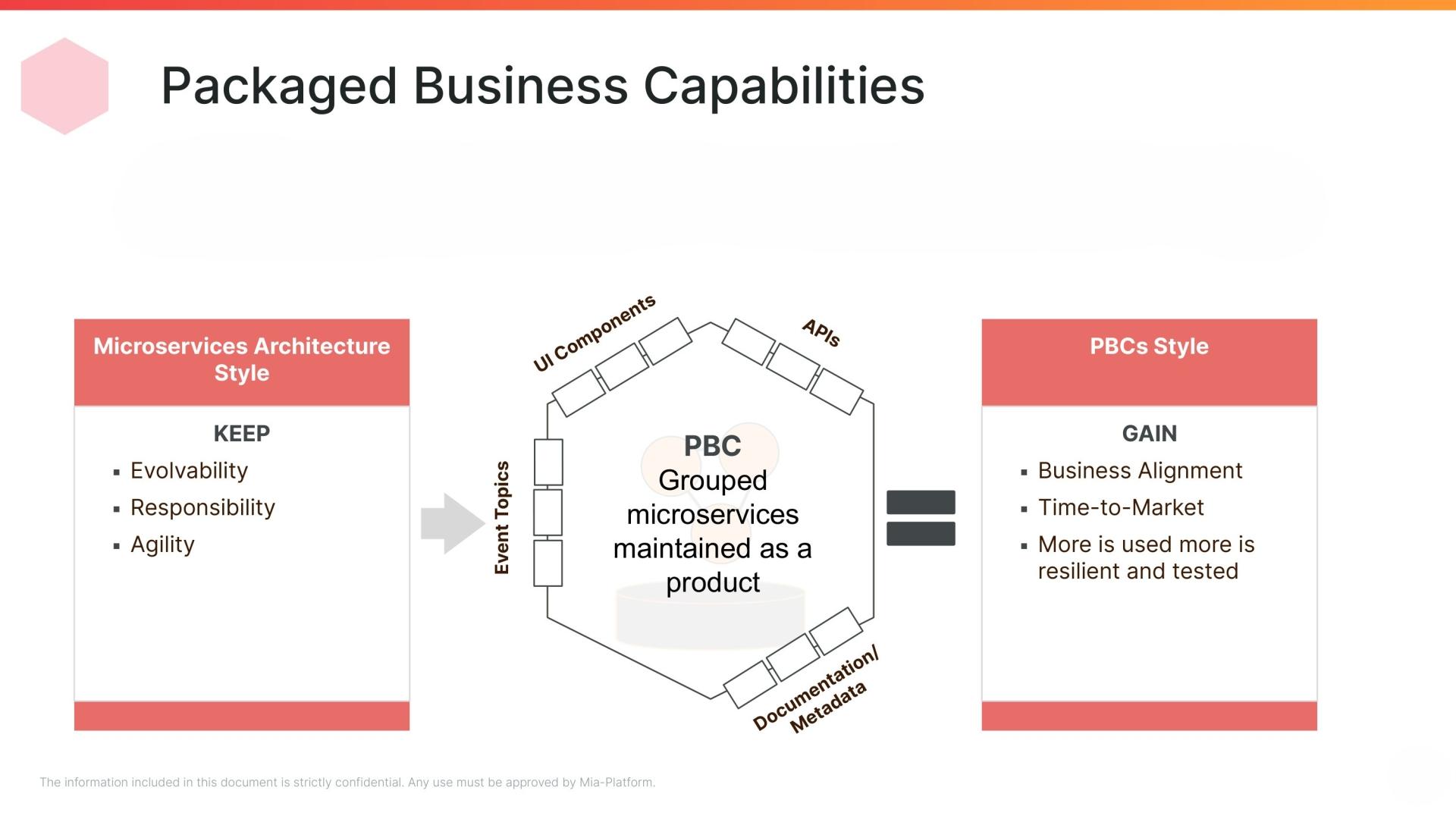
PBCs serve as the building blocks of composable architecture. Indeed, they are gradually paving the way for legacy businesses to pursue a composable, modular approach. PBCs enable organizations to respond quickly to market changes, reuse components, standardize offerings, and simplify ecosystem integration.
Most importantly, choosing to take a modular approach and leveraging standardized building blocks, businesses are empowered to become Composable Enterprises, being able to provide diverse business outcomes and a significant variety of value propositions.
Why You Should Turn Your Business Into a Composable Enterprise?
In order to respond to the market’s relentless evolution, companies need the proper agility to adapt quickly and efficiently. Embracing a composable enterprise model, built upon modular and reusable PBCs allows any organization to assemble and reassemble business capabilities as needed.
This marks another important step within the evolutionary ladder that shifts away from the complexities of monolithic structures and from the recurring pitfalls of overusing or misusing microservices alone. A composable approach enables organizations to respond faster to customer demands, optimize resource utilization, and foster innovation, setting the stage for significant advantages in an ever-challenging landscape.
Here’s a breakdown of the most important advantages of a composable business using PBCs:
- Increased business agility: PBCs allow organizations to adapt and evolve their digital offerings more readily.
- Faster time-to-market: Organizations can assemble and launch applications quickly by reusing PBCs.
- Improved efficiency and resource utilization: PBCs promote the reuse of digital capabilities, optimizing operations.
- Enhanced scalability and resilience: The modularity of PBCs enables easier scaling of capabilities and a more robust architecture.
- Better alignment between IT and business: PBCs represent business functions in a way that is understandable by the business.
- Reduced complexity and technical debt: PBCs offer a modular and well-defined approach compared to potentially flawed microservices implementations.
- Increased innovation: The ability to quickly assemble and experiment with PBCs fosters innovation.
- Improved discoverability and reusability: PBCs are designed to be easily found and used across different applications.
Intelligent composable enterprises leverage these holistic PBCs, which contain business logic to enable the creation of digital services and products, relevant bundled data for dependable insights, and potentially embedded analytics for smarter decision-making and automation. The primary goal is to deliver distinct business value and it can be easily achieved with the complementary use of modular and reusable PBCs, eventually empowering enhanced business agility and faster market entry.
Using an Internal Developer Platform for Easier Composable Approaches
Internal Developer Platforms (IDPs) are the technologies that enable this composable approach and allow the creation of a smart ecosystem by using orchestrators, composable applications, data, analytical models, and various capabilities.
Mia-Platform, for example, is an AI-Native Developer Platform Foundation that facilitates the creation and management of modular ecosystems of PBCs, emphasizing discoverability, composition, and reuse.
PBCs can be combined and recombined within the platform in several ways to get new products and services as needed by using specific tools, methodologies, and underlying capabilities that collectively allow for composition and orchestration of microservices and PBCs.
In essence, Mia-Platform provides a comprehensive suite of tools and architectural patterns that abstract any underlying complexity and empower developers to create, manage and orchestrate self-consistent, self-contained, business-aligned modules. These modules can also readily access and process necessary data and integrate analytical functions to deliver business value.
In Summary
The realm of application architecture has seen numerous changes in order to satisfy increasing and consistent needs for better business alignment and greater business agility.
Starting from monoliths, characterized by single, rigid units that incorporate all the application functionalities, we’ve witnessed a gradual shift towards more agile, distributed approaches. First, microservices grabbed the spotlight due to their versatility and simplicity to use and adapt. Later, overuses and misuses of microservices led to misunderstandings and wrong expectations from stakeholders.
This diffuse situation of misalignments and concerns resulted in the sprawl of Packaged Business Capabilities (PBCs), which can be referred to as self-consistent, easily discoverable modules that comprise microservices, data, APIs, and often UI components.
PBCs are the essential building blocks of composability and are to be intended as the starting point for a business to gradually become a composable enterprise, ultimately offering more flexibility as well as many relevant outcomes and value propositions.