Understanding Event Sourcing and CQRS Pattern

10 minutes read
10 April 2025

As modern software systems evolve, they take on larger tasks and a much greater role in society, and with that comes greater responsibility, complexity, and demand for reliability, scalability, and security.

Additionally, they must adhere to stricter compliance regulations, especially in sectors like financial services, where maintaining accurate records and ensuring traceability are crucial.

Imagine a financial services platform that manages user transactions and account balances. This system must deliver high performance while maintaining a detailed audit log for traceability. For instance, if a customer disputes a transaction, the platform should be able to reconstruct the exact sequence of actions that led to the current account state. Relying solely on traditional CRUD (Create, Read, Update, Delete) operations can complicate this process, as each update overwrites previous data, leaving little historical insight.

To overcome these challenges, modern software development turns to powerful architectural patterns such as Event Sourcing and Command Query Responsibility Segregation (CQRS), also known as CQRS Pattern. This article will explore how these patterns can improve system reliability, scalability, data consistency, and traceability. It will also highlight how they improve event management in complex systems, ensuring every action is recorded and easily accessible.


Event Sourcing vs CQRS

Before diving into the article, let’s first compare Event Sourcing and CQRS across key factors like their definitions, core concepts, use cases, advantages, and disadvantages.


Aspect Event Sourcing CQRS
Definition Design pattern that stores state as a series of events rather than the current state. Microservice communication pattern.
Difference Focuses on “what” happened (data persistence). Focuses on architectural separation (read and write responsibilities).
Core Concept Each change is recorded as an immutable event. Commands modify (write) data, while queries read data.
When to Use For systems requiring audit trails, historical data replay, or complex state recovery. When optimizing read performance separately from write operations.
Advantages • Full audit log
• Ability to replay history
• Reliable data recovery
• Easier debugging
• Improved performance and scalability
• Optimized for specific read/write patterns
• Better domain design
Disadvantages • Increased complexity
• Requires event versioning strategies
• Requires event versioning strategies (especially if used with Event Sourcing)
• Potential data synchronization issues
• May require additional infrastructure

What is Event Sourcing? 

Event Sourcing is an architectural pattern that tracks changes in a domain by recording them as immutable domain events in an append-only event store. Instead of simply storing the latest state in a data store, this approach preserves every change as a sequence of events. By replaying all the events in order, you can reconstruct the application or domain object’s state at any point in time.

What makes this method especially powerful is the depth of insight it provides. Rather than only seeing the current state of your application, your event store gives you access to the entire trail of decisions, actions, and changes that shaped it. This complete history becomes invaluable for debugging, auditing, and understanding complex business logic and behaviors.

Unlike the traditional state-based persistence model, which stores only the latest state and overwrites previous data with updates, Event Sourcing captures every change, preserving a complete history of events. For example, imagine an online banking app where users transfer money: 

  • In a traditional state-based system:
    • If Alice has $500 and sends $100 to Bob, the system updates her balance from $500 to $400. The old balance is overwritten, and the details of how it changed are lost.
  • In an event-sourced system:
    • Instead of directly updating the balance, the system records an event like Alice transferred $100 to Bob.
    • Later, if Alice disputes the transaction or you need to audit her account, you can replay all recorded events (e.g., Deposited $500, Transferred $100) to rebuild her balance at any point in time.

This fundamental approach of capturing every action as an immutable event lays the groundwork for the core principles that define how Event Sourcing operates.


Core Principles of Event Sourcing

The Event Sourcing pattern works because of these important principles:

  • Events: These are immutable records that capture every change in the system’s state. Each event represents a specific, distinct action or occurrence. For instance, in an e-commerce system, common events could include OrderPlaced, PaymentProcessed, and OrderShipped.
Events


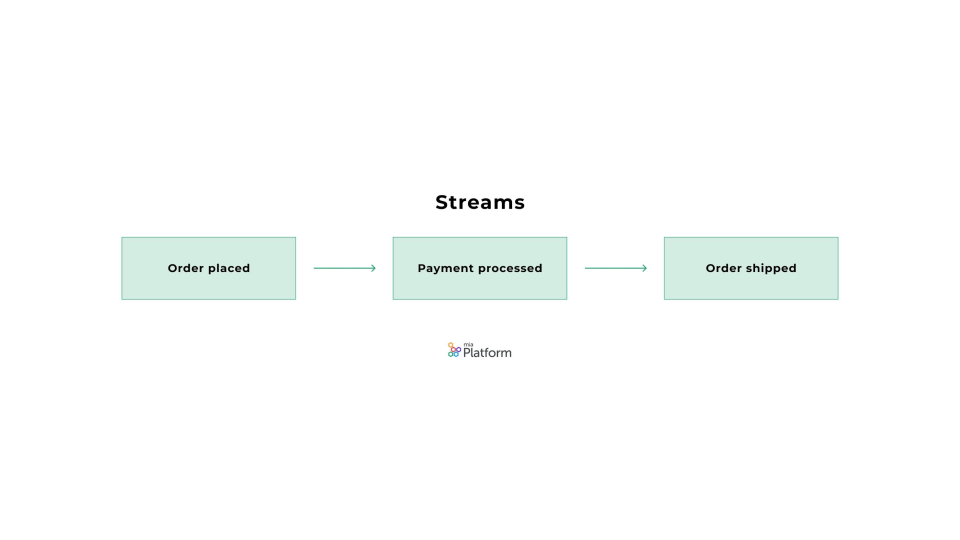
  • Streams: A stream is an ordered sequence of events tied to a particular entity or process. Continuing with the e-commerce example, a single customer order’s stream might look like this:
Streams


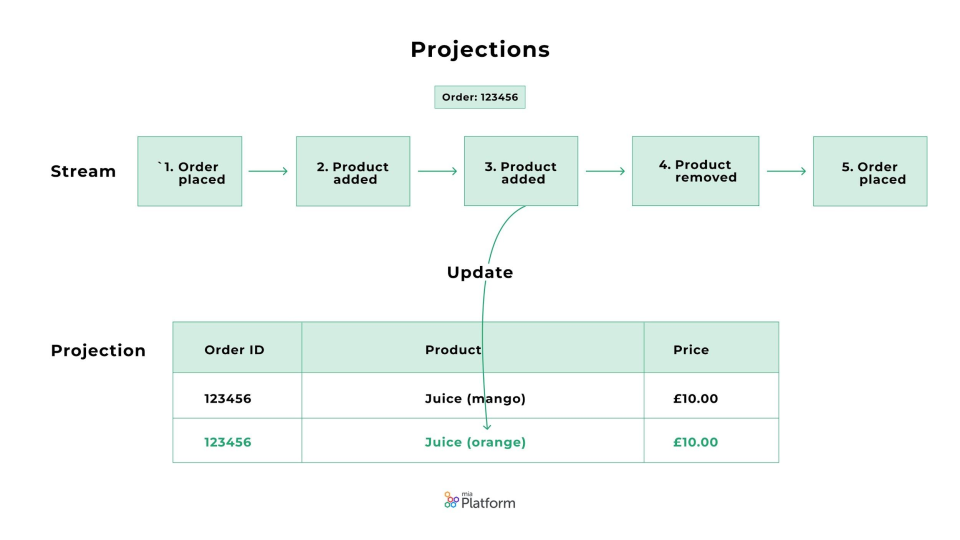
  • Projections: Projections are read models built from event data. They transform raw events into meaningful insights that applications can query efficiently. For example, projections can track total revenue, the number of orders per customer, and inventory stock levels.
Projections


Benefits of Event Sourcing

Event Sourcing offers numerous benefits that make it a powerful design choice:

  • Complete audit trail (Traceability): Every state change is recorded as an event, giving you a full historical log of what happened and when. This makes debugging, forensic analysis, and compliance audits significantly easier.
  • Data recovery and replay: By replaying events from the event log, you can reconstruct the system’s state at any point in time. This is invaluable for disaster recovery, restoring corrupted data, or investigating past issues.
  • Flexible projections: Projections let you create customized read models tailored to specific business needs. This allows for optimized queries without altering the original data.
  • Improved scalability: Event streams are naturally suited for horizontal scaling. Systems can consume and process events asynchronously, boosting performance in distributed environments.

At this point, it might not be immediately obvious, but Event Sourcing inherently separates write actions (events) from read actions (projections). This separation is a major reason why CQRS is often discussed alongside Event Sourcing, as CQRS further refines this separation into distinct architectural components.


What is CQRS?

Command Query Responsibility Segregation (CQRS) is an architectural pattern that separates a system’s read and write operations. Simply put, it promotes designing distinct pathways for handling commands (which modify data) and queries (for data retrieval).

A core principle at the heart of CQRS is that a method should either read or write data—never both. Additionally, queries should never change the system’s state; they should only return information. This ensures that read operations have no side effects on the data and are optimized solely for retrieval.


Why Separate Commands and Queries?

Splitting commands and queries offers several practical advantages:

  • Improved code clarity and maintainability: With each method dedicated to writing or reading data, the codebase becomes cleaner and easier to manage.
  • Enhanced scalability: Since read operations often outnumber write, CQRS allows you to scale your read model independently of the write model for better query performance.

Greater flexibility for complex systems: CQRS naturally fits event-driven architectures, where commands generate events and queries consume projections. This separation makes adding new features, like analytics or reporting, easier without modifying core complex business logic.


CQRS Pattern


How Event Sourcing and CQRS Work Together 

Despite its advantages, Event Sourcing introduces one significant challenge: increased complexity. Writing data in an event-sourced system seems straightforward: the application simply creates an event and adds it to an event log. However, retrieving data is far more complex.

To retrieve the current state of the data at any given point, the system must aggregate all relevant events up to that point in time. This process can be slow and unpredictable, making read requests significantly less efficient than writes. Managing both operations within the same data model can lead to major complications.

The root of these complications lies in the different needs between reading and writing operations. Additionally, many systems experience a clear imbalance between read and write operations. For instance, user-facing applications typically see far more reads than writes since users mostly consume data rather than modify it. Conversely, some systems, like a bank’s back office or a vehicle tracking platform, may experience heavier write loads than read requests.

Optimizing the data model for reads may involve adding indexes, which can slow down writes—and vice versa. This is where CQRS proves invaluable. By separating the read and write models, CQRS reduces complexity and allows each model to scale independently based on its specific needs.

Combining Event Sourcing with CQRS brings several additional benefits:

  • Change tracking: Since every state change is recorded as an event, you gain a detailed history that shows what happened, when, and why. These same event details make it easier to track data evolution.
  • Data auditing: The comprehensive event log naturally provides a robust audit trail, which is critical for accountability, compliance, and forensic investigation.
  • Contention reduction: By isolating read and write models, CQRS minimizes bottlenecks. Reads can leverage denormalized data optimized for fast lookups, while writes focus on maintaining transactional integrity.
  • Security enhancement: With distinct read and write models, you can enforce stricter controls on write operations while ensuring read data is widely accessible without compromising data integrity.

Summarizing: when an event occurs, it can trigger updates to one or more read models optimized for querying. This allows the write side to focus on capturing history, while the read side can provide optimized and tailored views of the data for efficient querying, which is a common application of the read side in a CQRS architecture. These unified, Single Views are typically projections built from underlying data changes.

Mia-Platform’s Fast Data significantly enhances Event Sourcing and CQRS through its asynchronous pattern. By leveraging a Kafka stream-based approach, Fast Data efficiently ingests and processes immutable events.

These event streams are then asynchronously used to materialize optimized read models (Single Views), aligning perfectly with the query side of CQRS. This asynchronous processing ensures that write operations (Event Sourcing) and read operations (CQRS via Single Views) are decoupled, improving responsiveness and scalability. 

The Fast Data Control Plane further simplifies the management of these asynchronous data pipelines, reducing the complexity often associated with implementing Event Sourcing and CQRS.


Fast Data


Wrapping Up

Traditional state-based persistence methods are becoming less effective in meeting the demands of modern applications. As systems grow more complex, the need for improved scalability, traceability, and performance becomes crucial. To address these challenges, organizations are encouraged to adopt patterns like Event Sourcing and CQRS.

These patterns provide a solid foundation for building scalable, secure, and reliable systems. They are especially beneficial in industries such as finance, healthcare, and real-time analytics, where accurate record-keeping and flexible data management are important.

However, implementing Event Sourcing and CQRS can be challenging, especially when compared to traditional state-based approaches. This is where solutions like Mia-Platform Fast Data become essential.

Mia-Platform Fast Data simplifies the development of event-sourced applications with CQRS by decoupling data ingestion from data consumption using asynchronous communication patterns. It ingests data from systems of record (SORs) into projections, ensuring a consistent and structured data layer optimized for efficient querying. This approach enables the separation of read and write models, improving performance and scalability. Additionally, Mia-Platform Fast Data allows for the creation of unified views by aggregating data from multiple projections, delivering a readily accessible, near real-time, and consistent data layer.

Check out the Mia-Platform Fast Data video demo for a detailed walkthrough on using the solution to implement Event Sourcing and CQRS.


Mia-Platform Fast Data Demo
Back to start ↑
TABLE OF CONTENT
Event Sourcing vs CQRS
What is Event Sourcing? 
What is CQRS?
How Event Sourcing and CQRS Work Together 
Wrapping Up