Adopting Platform Engineering on a Self–hosted Infrastructure

Numbers
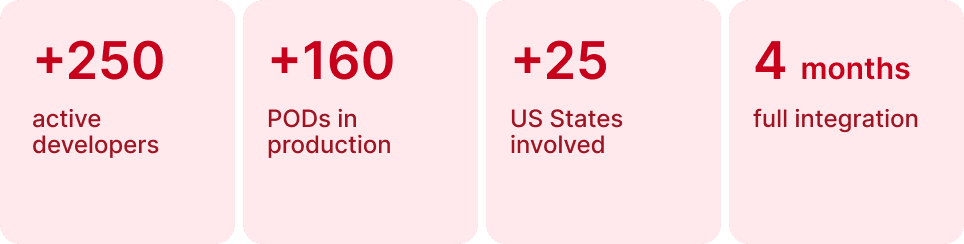
4 months
to integrate with existing infrastructure
- Challenge
- A leading US loan company, spread across 25 states, needed consistent governance and efficiency in its software delivery without losing control of its own self-hosted infrastructure.
- Solution
- Mia-Platform Console became the foundation of a customizable Internal Developer Platform (IDP), run as a product with its own team and golden paths, integrated with the company's existing self-hosted infrastructure.
- Outcome
- The IDP integrated with existing infrastructure in just 4 months, reducing developers' cognitive load and improving governance across a newly reorganized, agile IT structure.
A leading player in the US Loan Industry, embarked on a journey to accelerate its modernization strategy with platform engineering.
By partnering with Mia-Platform, the company developed its own Internal Developer Platform (IDP) to streamline IT operations, enhance governance, and ultimately make the software engineering practice more effective.
Main Benefits

Engineering Productivity

Improved IT Governance, Security and Compliance

Easing Scalability and Hosting

Reduced Infrastructure Configuration Costs
The Goal
The company faced the challenge of managing a dispersed workforce across 25 US States while ensuring consistent governance and efficiency in its development processes.
The ultimate goal was to centralize the governance in its IT factory to streamline software delivery and drive innovation. Additionally, the company aimed to address its need for customization when building its own Internal Developer Platform (IDP) and to pave golden paths for its development teams.
The Solution
In partnering with Mia-Platform, the company found a solution that not only met their immediate needs but also aligned with their long-term vision for developer empowerment and organizational excellence.
Mia-Platform Console emerged as the most comprehensive and customizable platform engineering solution on the market, offering a robust framework for governance, collaboration, and innovation.
Platform as a Product
One of the key requirements was integrating the new platform with the company’s existing self-hosted infrastructure. By leveraging Mia-Platform’s expertise and support, in just 4 months the company has been able to navigate the complexities of integration and customization with ease, ensuring a smooth transition and minimal disruption to ongoing operations.
Moreover, Mia-Platform’s Customer Success team prioritized comprehending the requirements and objectives of both technical and business units. They assisted the customer in building a robust enterprise-grade Internal Developer Platform (IDP), with the Mia-Platform Console serving as its foundation. This supported a system architecture centered around cloud-native principles and best practices.
As a result, the company was able to develop and manage its IDP as a product, ensuring more rigorous software design workflows and greater IT governance across the organization. This involved establishing clear product ownership, a dedicated platform team, and a continuous feedback loop to enhance features and capabilities.
Organizational Change
With the new platform-as-a-product mindset came a significant organizational change that transformed the entire IT factory structure. This shift involved evolving team structures, interactions, and mindsets to foster agility within a platform ecosystem. The IT organization was restructured into agile autonomous teams to work more collaboratively and cross-functionally, breaking down silos and encouraging continuous communication and integration.
As a consequence, onboarding employees onto the new platform became a streamlined and supportive process, ensuring that all developers, regardless of their prior experience, could quickly become proficient with the tools and methodologies provided by the IDP.
Composable Approach
Ultimately, the company fully embraced a composable business approach across the organization. Providing scaffolders, building blocks, and golden paths was crucial to provide a more compositional developer experience. By creating custom templates and reusable plugins on a shared software catalog, they ensured the spread of coding best practices and reduced development time. This marketplace of components facilitated service discovery, allowing developers to quickly find and integrate the tools and services they needed.
With these resources, developers gained the flexibility to choose their preferred level of abstraction and operate with greater autonomy. This self-service development approach enabled them to focus more on creating new features and delivering enhanced value. As a result, the cognitive load on developers was significantly reduced, improving Developer Experience. This led to faster time to value and overall enhanced efficiency across the organization.
Results
Partnering with Mia-Platform, the company adopted platform engineering by implementing a comprehensive, customizable Internal Developer Platform (IDP) that seamlessly integrated with their existing infrastructure fostering better IT governance and enhancing agility through evolved team structures and collaboration.
This transformation empowered developers with greater autonomy and flexibility, reducing cognitive load, improving Developer Experience, and accelerating time to value across the organization.
More case histories
















- Allianz
- ATM
- Aviitam
- Cattolica
- CNH
- Concrete
- Confindustria Dispositivi Medici
- Coop Etruria
- Coop.fi
- Crif
- Eolo
- Flex
- Gruppo Villa Maria
- HDI Assicurazioni
- Helvetia
- IIT
- Italo
- MD Concierge
- N-AND Group
- NeN
- Primo Caredent Group
- Quixa
- RBdigital
- Trenord
- Trieste Trasporti
- Unicoop Firenze
- Unicoop Tirreno
- Vodafone
- Youhealthy