Platmosphere 2025: Unleash The Invisible

Platmosphere 2025, the second edition of the in-person event dedicated to platform enthusiasts, has just come to an end.
With 450 attendees, 25 countries represented, 40 international speakers, and 150 companies involved, the conference organized by Mia-Platform confirmed itself as the flagship event as regards Platform Engineering.
Unleash the Invisible was the tagline of the 2025 edition. If you were wondering whether AI plays a role in this mysterious word-choice, definitely yes.
This year’s edition saw the compelling presence of AI as a hot topic in most speeches, and it is no news given the new Age of Enlightenment in today’s developer platform discourse brought about by AI – as a trustful companion to ignite human intuition, rather than replacing it.
But apart from the talks about Platform Engineering and AI in the strictest sense, what really made the day was the gathering of tech enthusiasts eager for learning, sharing their ideas, and putting into practice all those talks to innovate and shape a better future.
Let’s rewind the tape and do a quick recap with the key takeaways.
Where We Left off
During the Platmosphere 2024 edition, attendees had the chance to come into contact with Mia-Platform’s own idea about Platforms, that is single hubs to centralize and standardize Platform Engineering, Data Fabric, and Composability:
- Platform Engineering: the more infrastructural part of the software lifecycle, which provides a self-service development platform with highly accessible tools and services for the whole IT factory.
- Data Fabric: the massive realm of data, seamlessly connected to external systems and unlocked to become performant objects that ensure business continuity and agility.
- Composability: the possibility to apply business logic to specific services at will and/or reuse software assets that are available, thus creating a virtuous cycle between composing new services and reusing existing ones.
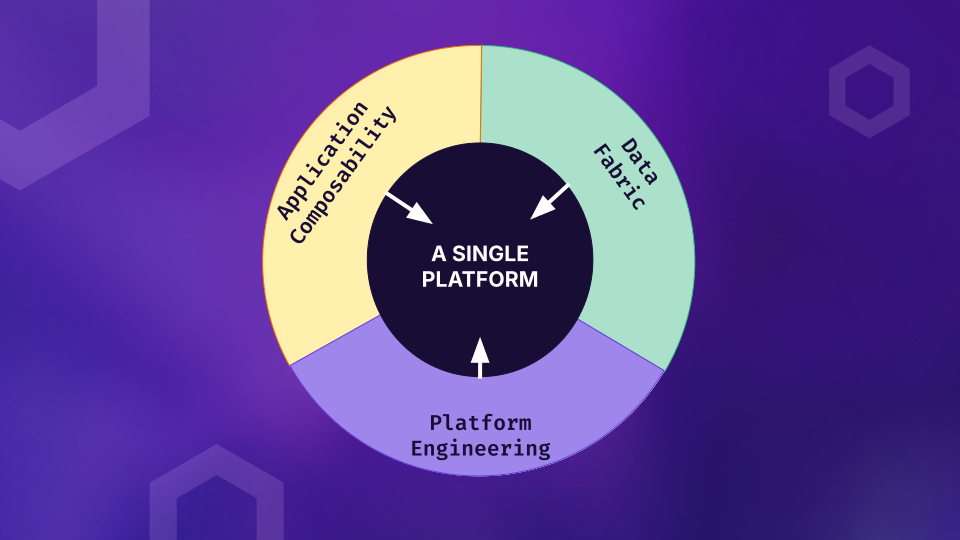
Within this framework, software represents a huge, yet almost invisible tile, which is unfortunately susceptible to become very layered and complex.
Platmosphere 2025: The AI (R)evolution
The arising AI models are promising unprecedented scenarios with tons of consequences.
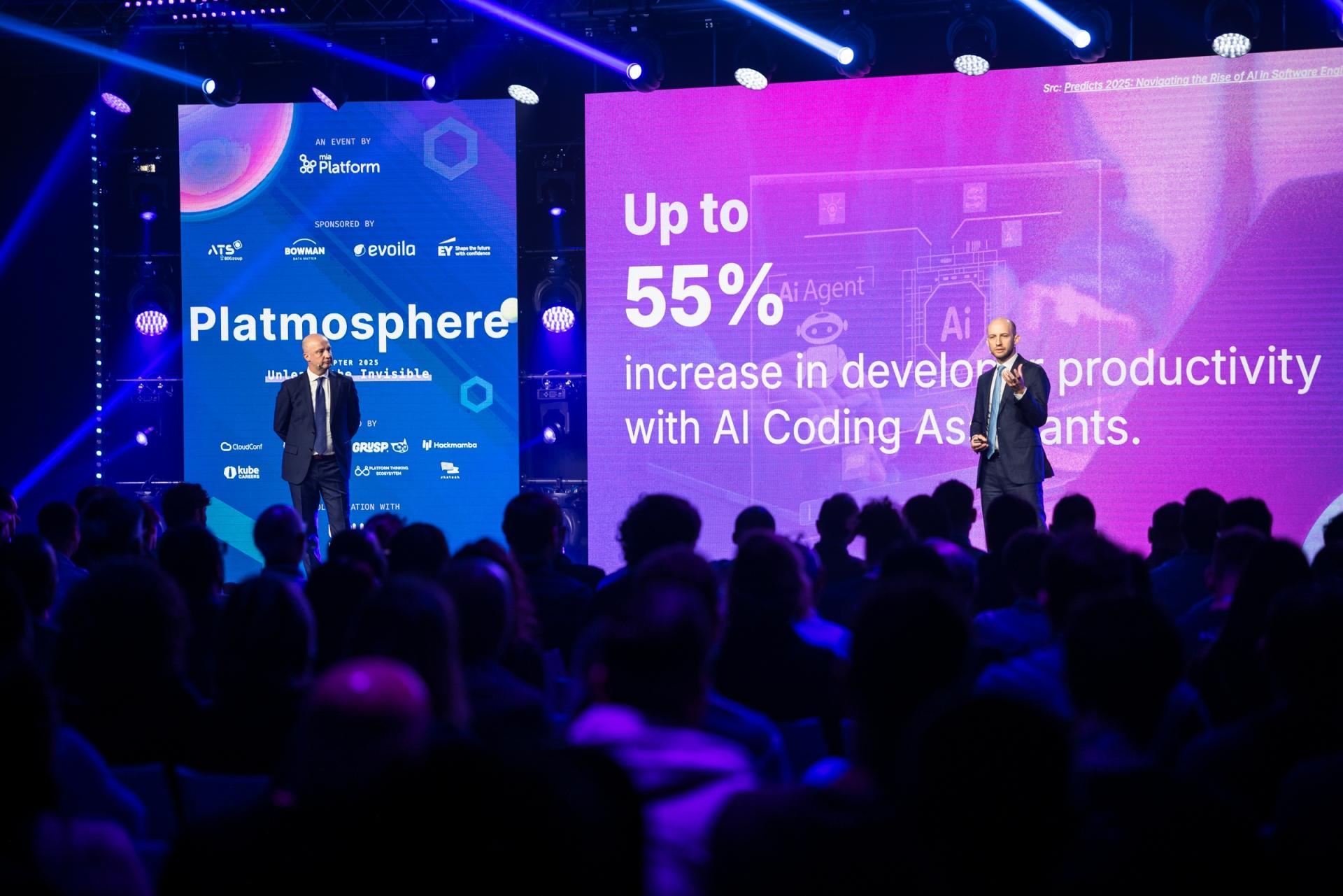
Francesco Soncini Sessa, Co-Founder, CFO and Head of Strategic Alliances at Mia-Platform, put it in this way:
“AI is likely a key player in the evolution of software. It’s a pervasive, cultural phenomenon that promises to offload cognitive load with unmatched speed and tailored outcomes […] AI can untangle the knot of software and help modernize.”
But is AI really entitled to become such a one powerful game-changer for software delivery? Well, yes… if we exercise caution.
Indeed, AI implications are many. Its integration into software development carries both advantages and concerns, challenges and opportunities (yes, chiasm intended!).
On the one hand the democratization of platform roles, a highly efficient and streamlined developer experience, a drastic reduction in costs, and a dramatic acceleration of time-to-market. On the other hand, potential hallucinations and new questions about data usage, privacy, security, intellectual property, and environmental impact.
So, where is the key? Are we supposed to ignore the AI (R)evolution and its impact on modern software delivery? Absolutely not. But we need precautions, namely better governance, security guardrails, and AI-ready data assets.
Most importantly, we need a platform which is imbued with a solid knowledge base across all its layers: in a nutshell, we need context.
Federico Soncini Sessa, Co-Founder and COO at Mia-Platform, stated:
“AI’s value exploded when harnessed for a purpose within a perfectly defined and tailored context […] We need to customize AI’s functioning to serve the people in our organization […] Rather than generic AI models, we must configure intelligent agents and systems with the ability to perceive the contextual environment: data, APIs, events […] Only in this way can we capture the true value of AI.”
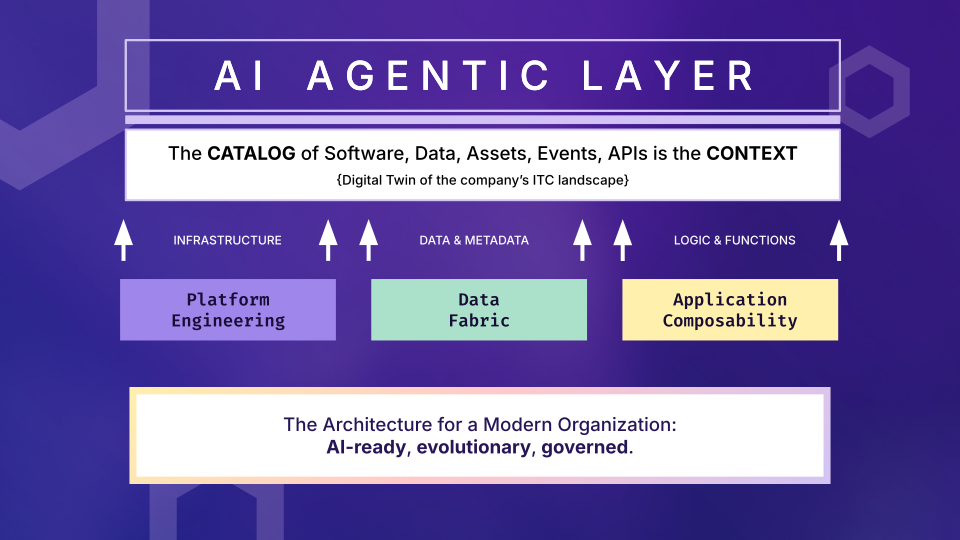
Here we are. What is the strength of an AI-powered Developer Platform Foundation?
Basically, it provides a comprehensive, centralized catalog containing information on all the company’s software, the semantics of the data, data as a product, APIs, and events.
In other terms, it’s a Digital Twin of a specific IT landscape.
The catalog layer becomes the very missing piece to centralize configurations, define purposes, and set guardrails. It becomes the needed context. In one place, the organization can configure guardrails, tools, and data for both manual and assisted development.
This way, the architecture is evolutionary, governed, and AI-ready. This is the promised revolution of platforms empowered with AI capabilities.
Long story short: a single architectural framework that features a user-friendly developer experience with ready-to-go components becomes even smarter with AI companions and agents that leverage the platform’s foundational context to streamline every single stage of the development lifecycle and democratize the platform itself, so that all the professional figures within the business can benefit from its usage.
A Use Case: The Antique Books E-Commerce
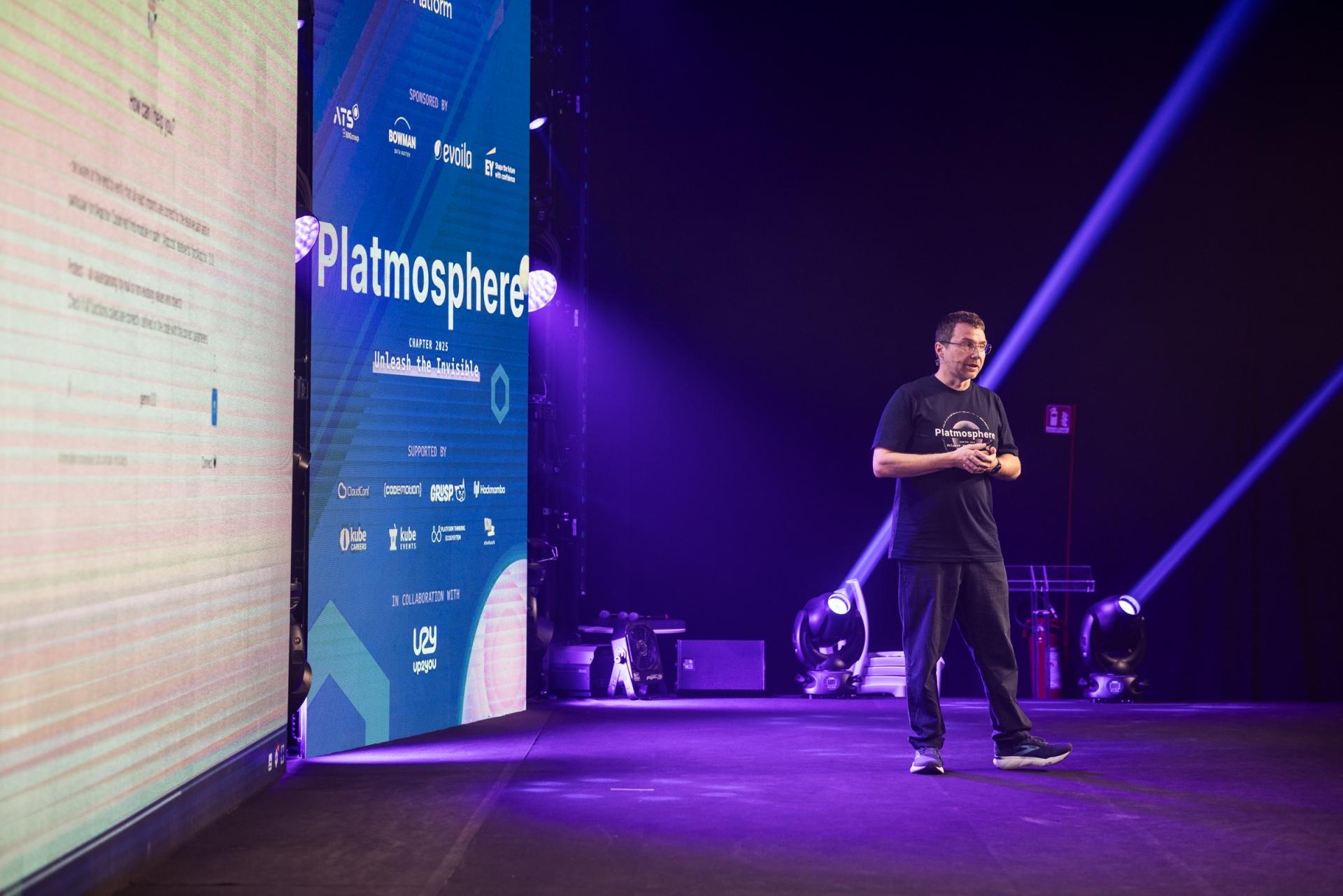
The opening keynote continued on with a brilliant demo performed by Giulio Roggero, Co-Founder and CTO at Mia-Platform.
Giulio let the audience have a taste of Mia-Platform’s latest achievements with an amazing use case: the construction of AI agents that wear many clothes and are able to read and analyze system requirements for a specific purpose, a cloud-native application. In this case, e-commerce for antique books.
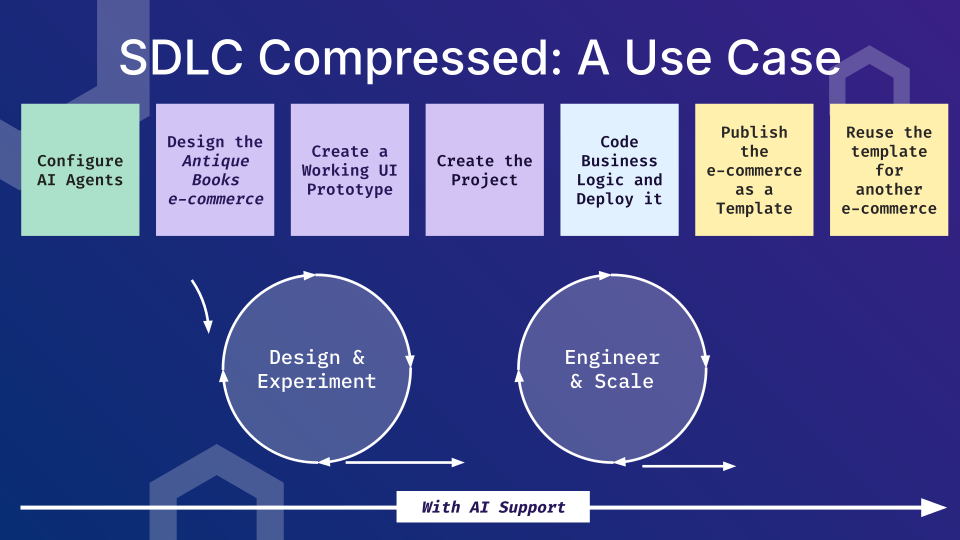
Throughout the software development lifecycle (SDLC), the agents leveraged all the items available within the platform ecosystem – the software and data catalogs, which serve as the context.
Whether you are a Project Manager with a non-technical background or a specialized Software Engineer, it is possible to interact with the platform at multiple levels. The platform enables the orchestration of diverse AI agents to speed up the SDLC, ultimately boosting innovation, reducing costs, and industrializing the product at scale.
Do you prefer a conversational, AI-first approach? Go for it. Are you more keen on coding? The choice is yours.
What you need to know is that the developer platform is your ultimate ally. A comprehensive tool to centralize platform engineering, data, and application composability. It is your single source of truth and context to feed your AI agents and orchestrate them across the entire IT factory.
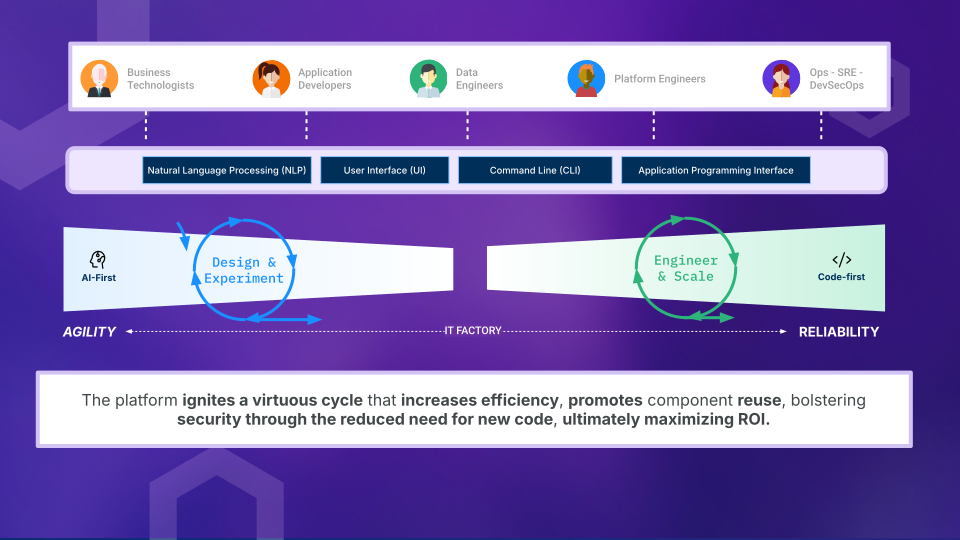
Consequently, the SDLC is simplified to just two phases: Design & Experiment, which is the prototyping phase in this use case, and Engineer & Scale, where the IT team releases the final product and maintains it.
Takeaways & Remarks from the MCs
The event featured one full day of stories and insights into Platform Engineering and AI from the community of platform enthusiasts and IT leaders.
This edition featured an extremely diverse lineup of speeches, spanning platform engineering boosting your business growth to firsthand experiences from industry leaders, and even tech workshops and hands-on demos for attendees.
Platform Business. Platform Stories. Platform Tech. Platform Labs.
So many tracks, and everyone had a say. Everyone felt really involved in a new seeking of knowledge. Last but not least, everyone had a blast!
Let’s finish this story with some notable remarks from the event’s Masters of Ceremony.
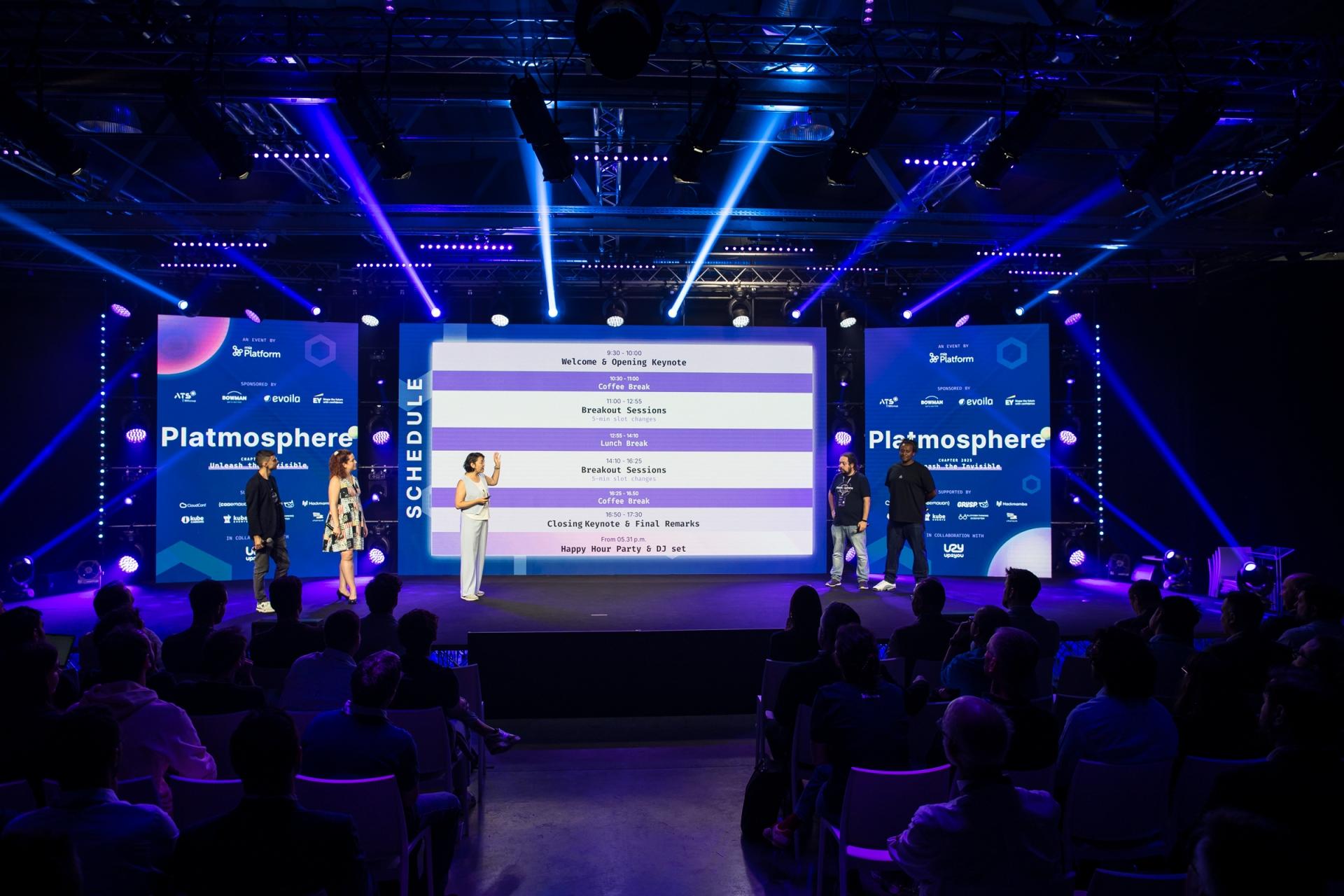
Lian Li
Lian Li, Cloud Native Human and Co-Chair for the CNCF TAG App Delivery, was amused by the latest interactions between Platform Engineering and AI:
“It was very interesting to understand that the business view today is much more about the design of application development, not just delivering and running it, especially because AI seems to be inevitable […] I’m very fascinated to see how the idea of platform just interacts with the entire software lifecycle, which also means a shift in philosophy from building services that make up a platform to conceiving platform as a whole and then zooming in on what services you would need for that. […] Using AI to build the design of your application doesn’t mean that it will run perfectly in production. I think that’s a very important point to see.”
She was also amazed by the latest trends within the industry:
“I’m also taking home two terms and I’ll be doing some research because I haven’t honestly heard about them before: Vibe Coding – did not know what that was – and Model Context Protocol.”
Jennifer Riggins
Jennifer Riggins, Tech Journalist and story-teller, was impressed by Mia-Platform’s capacity to hold such a green event:
“Today was proof that you can have a net-zero event. That should be the norm, and hopefully you’ll [Mia team] publish about how other events can accomplish that too. Tech events are next to the cloud for tech polluting, but not this one. So, congratulations on that, Mia!”
She enjoyed all the talks from her business track, but one really caught her attention:
“My favorite talk in my track was Susanna’s [Susanna Pavanelli, IT business partner at GVM Care & Research] because I think it’s exciting to see Platform plus AI for a proven human benefit. What could be better than applying AI to healthcare to not only find disease patterns, but to also understand how to better benefit the patient! Offering more transparent, open data can be enabled by a platform, which in turn empowers this user base, and I think that’s awesome.”
William Rizzo
William Rizzo, CNCF Ambassador and Consulting Architect at Mirantis, appreciated the empathy surrounding all the stories:
“What I saw was a constant factor, and I loved it. As a Lead Architect first and then as a Strategy Leader who’s consulting architects building platforms, I saw what I’ve been chasing with my clients, with my colleagues, with my peers. Developing or building something starting from the end user in mind. This is what I saw in my track.”
He kept on saying:
“It was a constant theme and a life motive. Building with empathy for your end users, for your developers, trying to understand what they need, also using AI agents that are architectural, agentic systems which are built around the context and are built to be used the same way the users would interact with the data. So, I think that as regards platform engineering, when we say that we are working around the developers, we are telling the truth. […] We put all these people together so that they better understand each other.”
Nicola Campagna
Nicola Campagna, Product R&D Manager at Mia-Platform, agreed with William and added some thoughts about the rise of AI:
“Yeah, I agree with William, so we saw similar things. Also, AI is here. AI is helping developers, and I think that almost all the speeches within our track today shared a common topic: AI is enhancing the developer experience. Well, that was the key. Because, in the end, Platform Engineering is likely about building a platform to help developers and reduce the cognitive load on them, and AI is a valid multiplier in doing so.”
Mich Murabito
Mich Murabito, CNCF Ambassador and Developer Advocate at Mia-Platform, loved all the conversations he had with people who attended:
“I invested a good part of the day at the Platform Experience Hub. We talked about technology, Platform Engineering and, of course, Artificial Intelligence. But I think the most important part of today was meeting the community and exchanging ideas. We did a lot of exercises, tried new things, discussed technological challenges and innovations, and, of course, we received a lot of feedback. We also talked a great deal about the Mia-Platform Expert program. […] I want to say thanks, thanks to the Solution Architects and to the Developer Relations team. It was crazy!”
For Better Development, For a Better Future
Platmosphere 2025 has finished, and it returned useful insights into the latest trends in the industry as well as solid certainties.
Composability, intelligent AI agents, augmented FinTech, AI-Powered Healthcare Software (SaMD), smart mobility, integrated DevSecOps, and sustainable software development.
Speeches on technical topics and successful business stories were numerous, but at the end of the day we came back with something even more precious.
Hopefully, all of this is not an end in itself, but aims at a deeper discourse: we as human beings are doing our best to shape a better society, a better world, a better future.
Because development doesn’t deal only with coding, but also with our growth as individuals, and our active role within a larger group of people to achieve shared goals.
Composable platforms with AI capabilities can walk us through this process of awareness, eventually enabling us to unleash the invisible.
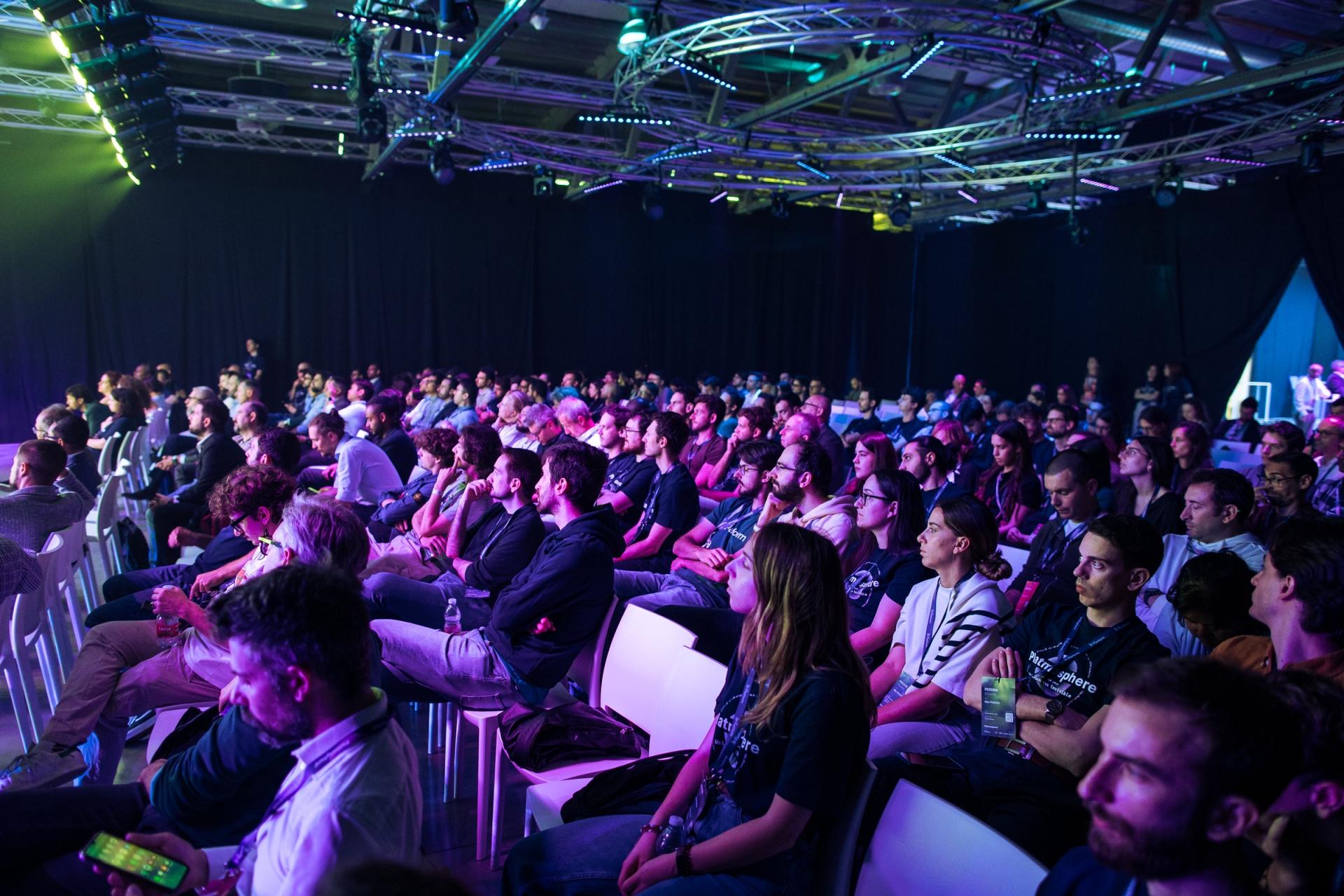
Oh, and don’t forget to save the date for Platmosphere 2026: the 3rd edition is happening on May 19th. Can’t wait to see you there!